Duke Humanoid V2 — Hardware
Everything needed to build an identical Duke Humanoid V2: what to buy, what to machine and print, how to assemble, wire and bring it up. The control code is open too: Software.
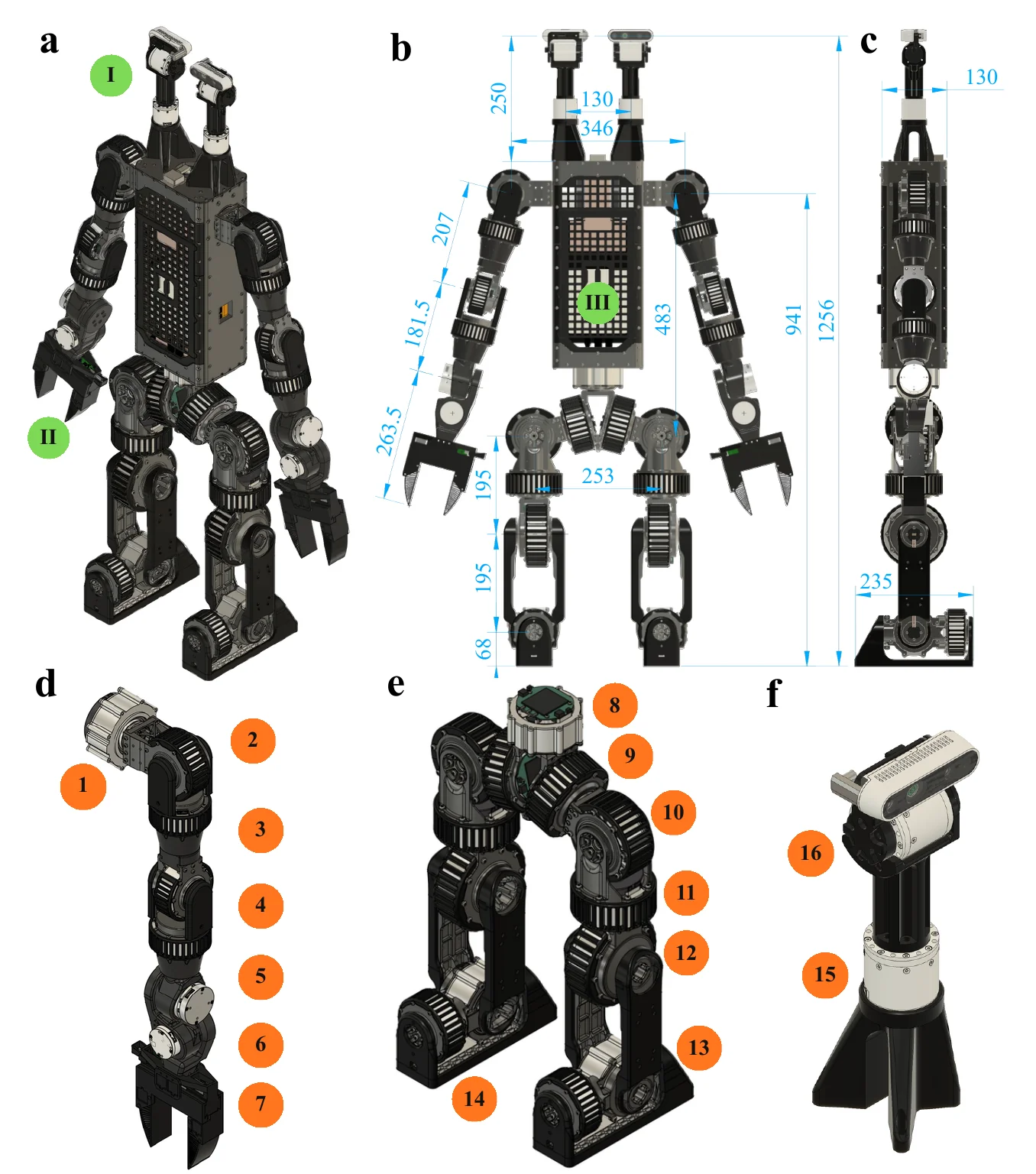
Build path
- 1 · Buy — every part, quantity and price. Bill of materials →
- 2 · Make — CAD files, 30 machined parts, 48 printed parts. Fabrication →
- 3 · Assemble — legs, arms, torso, camera columns, grippers, then the whole robot. Assembly →
- 4 · Wire — 48 V power, six CAN buses, every cable to make. Electrical →
- 5 · Bring up — motor IDs, zeroing, camera calibration. Bring-up →
- 6 · Verify — eleven acceptance tests, hung then walking. Acceptance tests →
At a glance
| Joints | 31 RobStride quasi-direct-drive actuators: waist 1, each leg 6, each arm 7, each camera gimbal 2 |
| Size and mass | 1.26 m tall with camera masts; 35 kg (CAD) |
| Cameras | 2 × Intel RealSense D436, each on its own yaw–pitch gimbal |
| Grippers | 2 × rack-and-pinion parallel grippers, one Feetech bus servo each |
| Power | 2 × 6S 10 000 mAh LiPo in series (44.4 V); 12 V for the computer and grippers |
| Computer | MINISFORUM X1-470 mini PC onboard; a separate CUDA machine runs the planner |
| Structure | Machined aluminium 6061 frame and joints; printed PLA, TPU and SLS nylon covers and brackets |
| Parts cost | $12,996.53 for the parts list; consumables, tools and shipping not included |
| Also needed | A gantry rated 50 kg or more with 1.4 m of clear height, and two people |
Full numbers: Reference.